
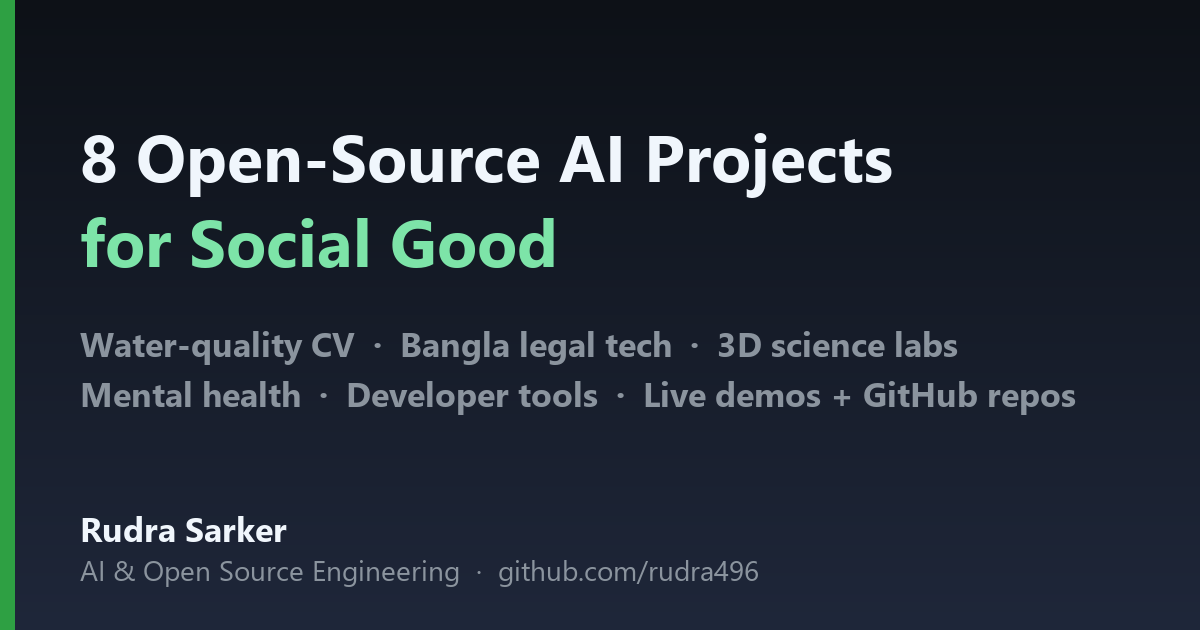
Most "AI for social good" demos stop at the demo. This post is the opposite: eight open-source AI projects I built from Bangladesh that are live, usable today, and have public GitHub repositories you can fork right now. They cover water-quality testing, court automation, education, mental health, and developer tooling — all engineered for low-resource, Bangla-first contexts.
Every link below goes to a live demo or the source code. Nothing is a mockup.
1. JolSetu — AI that reads a 20-taka arsenic test kit
Problem: millions of rural households in Bangladesh rely on hand-pumped wells, and arsenic testing is slow, paper-based, and easy to misread.
Approach: JolSetu turns a 20-BDT chemical test kit into a digital instrument. Take a photo of the kit next to a white reference card; computer vision using CIELAB colorimetry reads the color change, classifies the arsenic level, and speaks the result and next steps in Bangla. No lab, no internet dependency for the core read.
Links: Live demo at https://rudra496.github.io/jolsetu — source at https://github.com/rudra496/jolsetu
The project was completed and published in the Xylem Global Student Innovation Challenge and entered into the IEEE OneAquaHealth challenge, where it evolved into a team build with a full evidence pack.
2. AdalatAI — Bangla legal-tech for court workflows
Problem: court staff in Bangladesh draft and check documents by hand against dense legal rules; competent tooling is mostly English-only.
Approach: AdalatAI pairs a hand-crafted knowledge base of Bangla / Banglish / English crime-rule patterns (32+ rule types) with a trained classifier fallback covering 30 case types. The rule layer is primary because in legal work, a wrong but confident answer is worse than no answer — the deterministic layer keeps the system auditable.
Links: Live at https://rudra496.github.io/adalatai — source at https://github.com/rudra496/adalatai
3. ScienceLab 3D — a virtual science laboratory in the browser
Problem: thousands of schools have no working physics, chemistry, or biology lab.
Approach: interactive 3D experiments that run in a browser tab. Students manipulate apparatus, see realistic cause-and-effect, and repeat experiments without consumable costs. Shipped as version 1.0.0 and listed on the Extella app store.
Links: Live at https://sciencelab-two.vercel.app — source at https://github.com/rudra496/sciencelab3d
4. Porichoy — DPP-in-a-Box for garment factories
Problem: export factories drown in messy Excel, ERP, and paper records while EU buyers increasingly demand Digital Product Passports (DPP).
Approach: Porichoy turns that scattered records chaos into buyer-ready EU Digital Product Passports, with women data stewards operating the pipeline. It shipped through the NIC 3.0 Needle Challenge with 19/19 automated tests passing.
Links: Live at https://rudra496.github.io/porichoy — source at https://github.com/rudra496/porichoy
5. MindWell — mental-health support that knows its limits
Problem: developers burn out; generic chatbots either play therapist unsafely or are useless.
Approach: MindWell is deliberately non-clinical: a retrieval-based companion that returns evidence-based self-help resources and escalation paths instead of free-generating therapy. Risk-minimized architecture first, conversational polish second.
Links: Live at https://mindwell-navy.vercel.app — source at https://github.com/rudra496/mindwell
6. RippleUp — a production Compose Multiplatform app
Problem: social-media managers on small teams need scheduling that works offline-first on cheap Android phones and desktops alike.
Approach: RippleUp is a shipping product, not a portfolio piece: v5.3.3 in production, built with Kotlin, Jetpack Compose, and Compose Multiplatform 1.6.11, distributed as an Android APK and a Windows desktop build from one codebase.
Links: source at https://github.com/rudra496/RippleUpApp
7. CiteWarden — catching fabricated citations before reviewers do
Problem: LLM-assisted writing has created an epidemic of plausible-but-fake references.
Approach: CiteWarden checks manuscripts for citation integrity — verifying that references exist and actually support the claims they're attached to. Built for LexHack 2026 with a full automated test suite (22/22 passing).
Links: source at https://github.com/rudra496/citewarden
8. StealthHumanizer — honest AI text humanization
Problem: AI-drafted text gets flagged; crude "humanizers" just mangle prose.
Approach: StealthHumanizer is an open-source, multi-provider rewriting service with an optional self-hosted LLM backend, deployed on a VPS with Docker. It's transparent about what it does — the point is control over your own text pipeline, not deception.
Links: Live at https://stealthhumanizer.vercel.app — source at https://github.com/rudra496/StealthHumanizer
More open source from the same bench
The eight above are the flagships; the full public catalog runs deeper:
AI & simulation
- Hyper-Reason — autonomous test-time compute scaling and dynamic KV-cache sparsification for edge and local LLMs; a pure-PyTorch MCTS reasoning engine that cuts VRAM by ~65%: https://github.com/rudra496/hyper-reason
- EdgeBrain — lightweight edge-AI inference engine, sub-100 ms latency with no cloud and no API keys: https://github.com/rudra496/EdgeBrain
- Nexus Agent — zero-config, self-evolving local AI agent framework with multi-agent orchestration and GraphRAG, running 100% local on Ollama: https://github.com/rudra496/nexus-agent
- TrafficStudyGo — high-performance traffic simulation in Go: real-time flow modeling, signal optimization, intersection analytics: https://github.com/rudra496/TrafficStudyGo
- WorldSim AI — digital-twin simulation sandbox: https://rudra496.github.io/worldsim-ai/
- CityGuard AI — urban risk mapping: https://rudra496.github.io/cityguardai/
- Science Lab simulations — interactive physics, chemistry, and biology experiments with 3D visualizations: https://github.com/rudra496/science
- CNC Simulator Pro — free browser-based 3-axis CNC milling and G-code simulator with real-time 3D machining, feeds-and-speeds calculator, and 26 example programs, 100% client-side: https://github.com/rudra496/cnc
- AquaX — AI water-intelligence dashboards: https://github.com/rudra496/aquax
Developer & research tools
- AI Code Trust Validator — open-source security scanner for AI-generated code (pip install ai-trust-validator): https://github.com/rudra496/ai-code-trust-validator
- CodeVista — AI-powered code analysis and visualization with dependency graphs and architecture insights: https://github.com/rudra496/codevista
- TermMind — terminal-based AI mind mapping and brainstorming: https://github.com/rudra496/termmind
- Spark — toolkit for validating OSS repository structure and scaffolding project foundations: https://github.com/rudra496/spark
- SignLanguage-Dataset-Hub — a 5,062-video sign-language corpus evidence map: https://github.com/rudra496/SignLanguage-Dataset-Hub
- SightlineAI — assistive smart-glasses software: https://rudra496.github.io/sightlineai
- DevRoadmaps — curated developer career roadmaps: https://rudra496.github.io/devroadmaps
- Z.AI SDKs — community Python and Java SDKs for the GLM API: https://github.com/rudra496/z-ai-sdk-python
Community & curated lists
- Z.ai National AI Hackathon — Bangladesh 2026 — the multi-track, multi-university hackathon organized as Z.ai Ambassador: https://github.com/rudra496/zai
- Youth Tech Forum — community platform for youth tech engagement: https://github.com/rudra496/ytf
- awesome-ai-humanizers — curated list of AI humanizer and detector tools, research, and resources: https://github.com/rudra496/awesome-ai-humanizers
- awesome-microsoft-student-resources — genuinely free Microsoft resources for students: https://github.com/rudra496/awesome-microsoft-student-resources
Social impact & web
- JhutPass — trust infrastructure for Bangladesh's jhut (textile-waste) recycling economy, IPESphere Season 2 prototype: https://github.com/rudra496/jhutpass
- Love You Mom — interactive digital memory book and tribute app: https://github.com/rudra496/loveyoumom
- Portfolio v2 — Next-generation engineering portfolio: https://github.com/rudra496/site2
What ties these together
Three engineering rules recur across all eight projects:
- Deterministic where it matters. Legal rules, colorimetry math, and test-kit reading stay hand-verified; ML only fills gaps.
- Bangla-first, not Bangla-translated. Low-resource language support is designed in from the data layer up.
- Open by default. Every project above has a public repository — if it dies, the community can resurrect it.
If you work on water safety, legal tech, or education tooling for South Asia, I'd love to compare notes — find me on GitHub at https://github.com/rudra496 or LinkedIn at https://www.linkedin.com/in/rudrasarker.
Comments(0)
Join the discussion securely with your ZyVOP account.
Continue on ZyVOP to CommentNo comments yet. Be the first to comment!